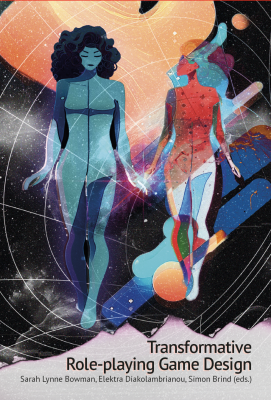
Transformative Role-playing Game Design

Authors

Sarah Lynne Bowman (ed)
Uppsala University
https://orcid.org/0000-0003-1277-8787 (unauthenticated)
Elektra Diakolambrianou (ed)
Dragons' Nest, Institution for Counselling and Psychological Studies in Athens
Simon Brind (ed)
Avalon Larp Studio, British Broadcasting Corporation (BBC)

Keywords:

RPG, role-playing games, psychology, counseling, counselling, role-playing game studies, larp, live action role-playing games, tabletop, identity, transformative, transformation, bleed, alibi, integration, safety, accessibility, narrative, ritual, conflict, culture

Synopsis

This textbook describes theory and practice in analog role-playing game (RPG) design that encourage specific transformative impacts in participants, including tabletop, live action role-playing (larp), and Nordic and American freeform. We describe three types of transformative RPGs: transformative leisure, therapeutic, and educational. We present our model of nano-game design, offering recommendations for designing transformative goals; framing activities such as workshops and debriefs; narrative and culture design. 

This interdisciplinary book highlights theories from role-playing game studies, peace and conflict studies, psychology, social psychology, sociology, counseling, anthropology, pedagogy, and several other fields. Key concepts include bleed, alibi, RPGs as transformational containers, immersion, identity, transfer, ritual, psychotherapeutic techniques, group theories, and educational theories. We emphasize psychological safety before, during, and after games, as well as strategies for cultivating transformational communities. Key topics include working with specific populations; crisis management; sensitive content and representation. 

Then, we discuss working with myth, symbolism, and ritual, narrative, and postmodern magic as methods for transforming the stories of our lives. We cover forms of culture within and around RPGs, as well working with conflict in scenarios related to politics, culture, gender, sexuality, race, and ethnicity. We share thoughts around the use of RPGs to foster activism, advocacy, inclusion, and accessibility. 

Finally, we offer considerations for researchers studying transformative role-playing games, including academic argument, structure, theory, method, data collection, ethics, and other considerations. We introduce key methods, including Research through Design, ethnography, and qualitative and quantitative data analysis. The book closes with a summary of evidence-based research available on the cognitive, affective, and behavioral effects of role-playing games.

Chapters

Author Biographies

Sarah Lynne Bowman, Uppsala University

Sarah Lynne Bowman is a scholar, game designer, and event organizer. She received her B.A. and M.A. from the University of Texas at Austin in Radio-Television-Film and her Ph.D. from the University of Texas at Dallas in Arts and Humanities. Bowman has taught in the Humanities, English, and Communication. Currently, she is an Associate Professor and Docent in Game Design at Uppsala University Campus Gotland. She formerly served as Coordinator for the Peace & Conflict Studies program at Austin Community College, where she teaches Humanities. Bowman is a founding member of the Transformative Play Initiative, who research analog role-playing games as vehicles for personal and social change. She co-edited The Wyrd Con Companion Book (2012-2015) and currently edits for the International Journal of Role-Playing and Nordiclarp.org. Bowman has co-organized several conferences, including Living Games (2014, 2016, 2018), Role-playing and Simulation and Education (2016, 2018), and the Transformative Play Initiative Seminar (2022). More information at sarahlynnebowman.com.

Elektra Diakolambrianou, Dragons' Nest, Institution for Counselling and Psychological Studies in Athens

Elektra Diakolambrianou (Ilektra Diakolamprianou) is a licensed psychologist and psychotherapist, a certified adult educator, and a larp designer. She has a B.Sc. in Psychology from Panteion University, a Pg.Dip. in Person-Centred Counselling from the University of Strathclyde, a Prof.Cert. in Art, Drama and Play Therapy from Edexcel, and is a European Certificate of Psychotherapy holder. Currently she is pursuing a M.A. in Creative Writing offered by the Hellenic Open University. A certified trainer of communication skills by Gordon Training International and member of the trainers’ pool of the Greek National Agency for Erasmus+ Youth 2014-2020, Elektra has had continuing education in cinematherapy, music therapy, bibliotherapy, therapeutic writing, gamification methods, game-based education, restorative justice, and social psychology. Since 2012, she has been working as a psychotherapist working with socially vulnerable groups, including: unaccompanied minors, refugees, immigrants, NEETs, unemployed people, former prisoners, and women. Since 2013, she has been an academic staff member at the Institution for Counselling and Psychological Studies in Athens. Her academic work emphasizes the potential of larp as a medium for personal development and psychotherapy. She is also a co-founder of the LARPifiers. Elektra
has experience in working as an emotional safety person in games and projects, as well as in curating larp designs for emotional safety.

Simon Brind, Avalon Larp Studio, British Broadcasting Corporation (BBC)

Simon Brind is a larp writer and academic from London, England. He received his Bachelor’s degree in English Literature from University College London, has a Master’s degree in Software Engineering from the University of Westminster, and a second Master’s in Creative Writing from Middlesex University. He completed his Ph.D. in 2023 at the Digital Cultures Research Centre at the University of the West of England. His thesis, Combat Narratology: Strategies for the Resolution of Narrative Crisis in Participatory Fiction, is available from the Digital Cultures Research Centre, (UWE), Bristol. His research looks at emergent narrative structures in participatory fiction and the tension between authorial and participant agency. He has been a larper since 1983, a larpwright since 1986, and is a founding member of Avalon Larp Studio. He has
worked on some of the largest and longest running larp systems in the UK as well as projects across Europe and North America.

Angie Bandhoesingh, Dragons' Nest

Angie Bandhoesingh (Antzela-Sita Bandhoesingh) is an educator and larp designer with extensive experience in non-formal education. She has an educator’s degree from the Literature, Philosophy and Psychology department of the National an  Kapodistrian University of Athens and has worked as a private tutor, a child animator, and a non-formal education facilitator since 2010. She has experience in youth work across multiple projects, including several in Erasmus+. Angie is a co-founder of the Dragons’ Nest nonprofit organization (formerly RPG4Kids), is the company manager, and is the educational content supervisor for extracurricular school activities for children aged 5-12. She also co-founded the LARPifiers non-profit organization, where she is an edu-larp designer and organizer, including having co-designed the grant-funded edu-larp Superhero Union. A larper since late 2015, she has been an organizer of local larps from 2016-2019. She has been exploring arts and crafts as a way of personal expression and informal learning activities. Her interest in non-formal education stems from a desire to transform formal education into a children-friendly, student-centric environment.

Kjell Hedgard Hugaas, Uppsala University

Kjell Hedgard Hugaas is a Northern Norwegian game designer, organizer, writer, theorist, and trained actor. In particular, he is engaged within the Nordic larp tradition, where he has been active for a bit over two decades. The last few years he has explored the transformative potential of games, and has proposed specific intentional game design practices that facilitate transformative effects. As well as being a founding
member of the Transformative Play Initiative, Hugaas has theorized how ideas impact players through the processes of memetic bleed, procedural bleed, and identity bleed. His work on bleed has so far culminated in his 2022 Master’s thesis in Game Design at Uppsala University, and he is planning to expand on this theoretical work in the future. In 2023, he completed a second thesis for UU on the impacts of larp on participants’ attitudes and anxieties around death. In addition to his project assistant work on EDGE and the Erasmus+ Cooperation Partnership ROCKET, he is the co-founder and CEO of the game studio and research company Evocative Games AB, where he currently works as a consultant, researcher, narrative designer, and writer.

Alessandro Giovannucci, Chaos League, University of Teramo, University of Chieti

Alessandro Giovannucci is an award-winning game designer and theorist working in the field of larp and immersive experience. He co-founded the larp collective Chaos League in 1992 and wrote the manifesto “Southern Way – New Italian Larp.” His work focuses on political and social topics, experienced through the participatory nature of larp. He has worked on different formats and styles of games, going from small ones (First They Came) to some of the bigger and most successful international larps (Sahara Expedition, Miskatonic University). Very active in the field of online larp, he designed games and organised several online festivals in the last years including the International Larp Festival. Alessandro is also regularly invited to host talks, larp design workshops and seminars all over Europe and their games are hosted in some of the most important festivals. Has already participated, both as a partner and leader, in European funded projects related to larp, civil rights and education. Alessandro is also a music teacher at the University of Teramo and University of Chieti, researching the relationship between materialism and storytelling in the arts.

Guus Quinten van Tilborg, Groningen University

Guus van Tilborg is a Ph.D. student at Groningen University. Originally from the Netherlands, he recently graduated with a Master’s degree in Game Design from Uppsala University Campus Gotland. Guus received an M.A. in History (American Studies), an M.S. in Social-Cultural Anthropology at the University of Amsterdam, and a Bachelor’s degree in Anthropology at the University of Minnesota, Twin Cities. Besides his academic pursuits, Guus has been actively teaching in various settings, ranging from language tutoring college students to teaching immigrants civics and history. Throughout his career, the central theme has been “belongingness” and how to make people feel welcomed and accepted: a theme that also happens to be his main research interest. Guus is a volunteer with Erasmus+ EDGE.

Josephine Baird, Uppsala University

Josephine Baird is a lecturer at the Uppsala University’s Game Design Department and a Ph.D. candidate at Tampere University. She is a game designer and game design consultant, as well as a writer and visual artist. Her work often relates the intersection between games, identity, gender, and sexualities. Her research and recent publications present the theoretical and methodological basis for her thesis that role-playing games might provide a potent opportunity for people to explore their gender subjectivity in safer environments. Her current research will conclude with the design of a live action role-playing game that puts this theoretical work into practice. She is also an actor, public speaker, and co-host of the podcast It Is Complicated. More information can be found at https://josephinebaird.com/.

Josefin Westborg, Uppsala University

Josefin Westborg is one of the world’s leading designers in edu-larps. She has a background in game design and pedagogy and is one of the founders of Lajvbyrån (previously LajvVerkstaden Väst). Josefin has worked as a research assistant and teacher at Uppsala University’s Department of Game Design where she was a founding member of the Transformative Play Initiative with focus on analog role-playing games. Westborg codesigned curriculum for Uppsala’s Master’s in Transformative Game Design and has worked as a teacher in its introductory courses, upon which EDGE is based. She has also been a teacher in game design at both Chalmers University of Technology and the University of Gothenburg. She recently published an article for the International Journal of Role-playing entitled “The Educational Role-Playing Game Design Matrix: Mapping Design Components onto Types of Education.” In addition to EDGE, she also works as a project assistant in the Erasmus+ Cooperation Partnership ROCKET. Throughout her career Josefin has met thousands of students of all ages, and run and designed larps for them. She is passionate about designing for interaction, storytelling and learning. When she is not involved with games you will probably find her at the dance studio doing ballroom dance.

Taisto Suominen, Turku University of Applied Sciences

Taisto Suominen is an Associate Professor at the School of Information and Communications Technology of Turku University of Applied Sciences in Game and Interactive Technologies. He holds a Master of Engineering degree and has worked for 20 years in TUAS. He is a cofounder of Turku Game Lab and its predecessor Game Tech Arts Lab. He has been an active and key person on the TUAS game development curriculum design and Turku Game Scene activities. He was a board member of Neogames Finland 2018-2021 and continued in 2022 and 2023 as an observer member of the board. Neogames is a nonprofit association for the game industry to coordinate and support the growth and development of the Finnish game industry. His research interests include utilization of game and interactive technologies on various domains, serious and entertainment games, extended reality, game graphics and content creation.

cover image

Published

January 24, 2025

Online ISSN

3035-7934

Print ISSN

3035-7594

Details about the available publication format: Buy (softcover)

Buy (softcover)

ISBN-13 (15)

978-91-513-2301-5

Physical Dimensions

How to Cite

(Ed.). (2025). Transformative Role-playing Game Design: Vol. Transformative Play Research Series, 1. Uppsala Scholarly Books. https://doi.org/10.33063/23xd2197